Airhead GS Paralever driveshaft
Curious about how the Paralever works? Try reading this.
Geometry
Ride height was measured from the center of the shock bolt on the rear drive to the top of the rear subframe.
Shock length was measured eye-to-eye, centers. Full shock extension was taken from the free length of my Fox Twin-Clicker, and full compression was estimated based on the apparent travel of the shaft.
Swingarm (driveshaft) angle was measured at the transmission (proximal) and at the rear drive (distal). These measurements aren't very precise; I'll try to repeat them with better instrumentation.
Charts
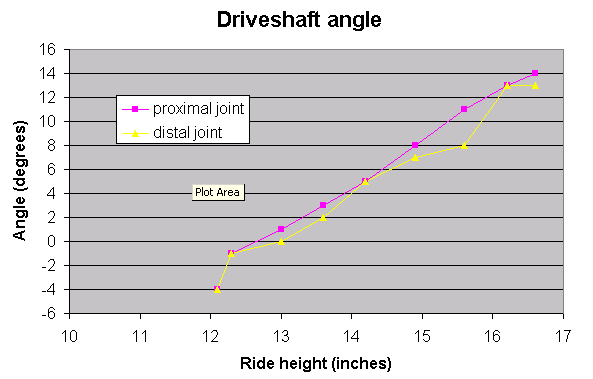
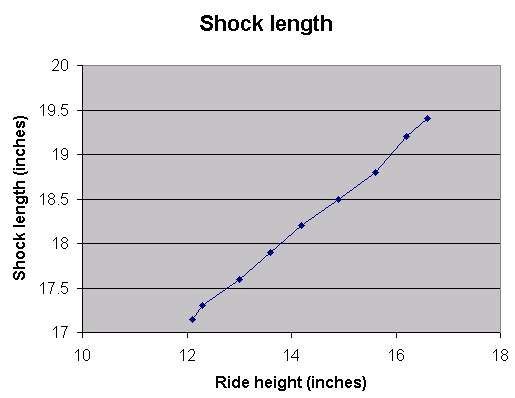
Raw data
| Height | Shock length | Proximal angle | Distal angle |
|---|---|---|---|
| 16.1 | 19.4 | -14 | 18 |
| 16.2 | 19.2 | -13 | 13 |
| 15.6 | 18.8 | -11 | 8 |
| 14.9 | 18.5 | -8 | 7 |
| 14.2 | 18.2 | -5 | 5 |
| 13.6 | 17.9 | -3 | 2 |
| 13.0 | 17.6 | -1 | 0 |
| 12.3 | 17.3 | 1 | -1 |
| 12.1 | 17.15 | 4 | -4 |
U-joints
Some of them fail. Some don't. Here's what a rebuildable driveshaft from Bruno looks like:
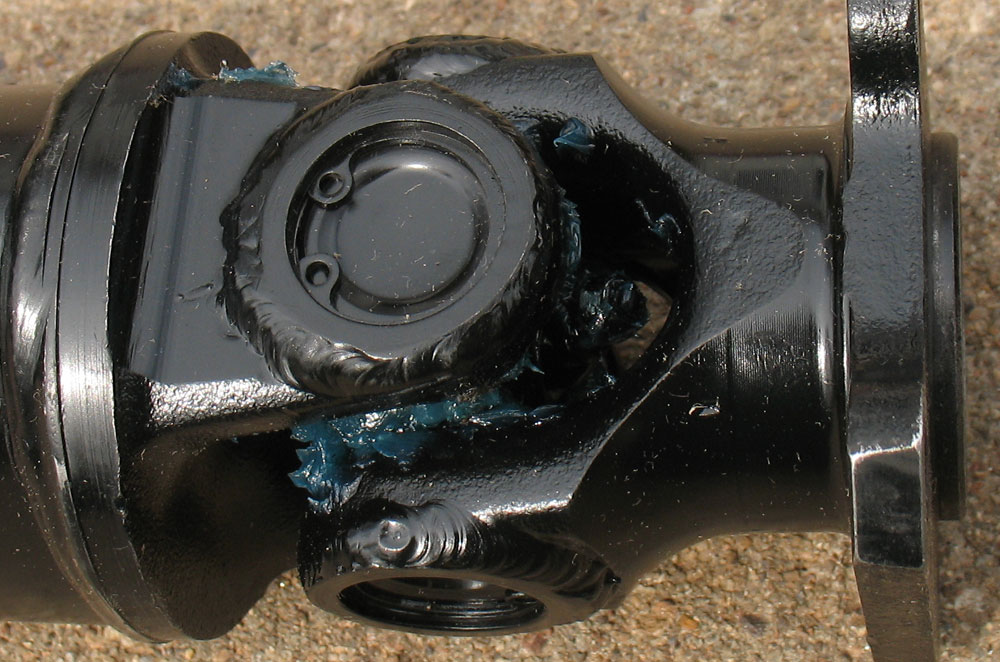
You can also get rebuilds from HPM and Erich Demant (in Germany).
R1150GS driveshaft
Rod Neff made the following observations about his bike:
| Position | Proximal | Distal |
|---|---|---|
| full ext | -17.2 | 3.5 |
| -4 | 0 | |
| 0 | -2.5 | |
| full comp | 7.5 | -10 |
Driveshaft inspection
I replaced my driveshaft at 64,000 miles. I had no real indication that anything was wrong but I didn't want to be stranded on some upcoming rides. I had removed it at 48,000 miles and felt a very slight bit of play when the ends were turned against each other. A local rider checked it and said, "that's the beginning of the end" but I didn't see how much tighter they could really be.
Well, when I got the new one, I tried twisting that thing and there was NO movement no matter how hard I tried. It's clear to see that "no play" really means NONE. But I also noticed that the bearing end caps didn't seem to be evenly recessed in the yokes, so I got out the calipers and took some numbers. The measurements are listed in inches with the following identifiers:
STAKES: the recess distance from the machined flat of the yoke down to the bearing cap where it is staked in position
FLATS: distance across the two machined surfaces of the yoke
CENTER: on the center (floating) part of the shaft
FIXED: on the end pieces of the U-joints
DAMPER and SOLID: the shaft end; damper is the front and solid is the rear
| New | Old | Data point |
|---|---|---|
| DAMPER END | ||
| 1.880 | 1.881 | Center flats |
| .059, .089 | .064, .064 | Center stakes |
| 1.732 | 1.753 | Spacing |
| Cross-check | ||
| 1.881 | 1.887 | Fixed flats |
| .065, .089 | .054, .051 | Fixed stakes |
| 1.727 | 1.782 | Spacing (this one had about 1mm play in the joint) |
| Cross-check | ||
| SOLID END | ||
| 1.881 | 1.884 | Center flats |
| .069, .077 | .055, .070 | Center stakes |
| 1.735 | 1.759 | Spacing |
| Cross-check | ||
| 1.887 | 1.882 | Fixed flats |
| .068, .086 | .077, .074 | Fixed stakes |
| 1.733 | 1.731 | Cross-check |
| Spacing |

