Slow School
Introduction
Learning to make sharp turns at slow speeds is the single biggest improvement in my riding that I've made this year (2003). It really focuses on the bike's balance and how the bike responds to acceleration a steering, and I find myself incorporating the techniques into more of my everyday riding.
I want to draw specific attention to the fact that, at least in the beginning, the technique for doing tight turns is a different technique than normal riding. Eventually it becomes clear that they are quite similar, but merging them probably won't happen for a while. The "Look, Lean, Roll" and "Look through the turn" that we are taught initially keeps the motorcycle and the bike's path in our peripheral vision, while the extreme version used for U-turns has you unable to see the path or even the motorcycle - it relies on your ability to use the controls without looking at them and without seeing the path you're steering. Eventually you will see that they are actually the same technique underneath, since they both require that you look to your destination and then bring the motorcycle around to reach it.
The distinction is important because you cannot properly practice the U-turns by merely making tighter and tighter turns using your existing technique (looking in front of the bike). You will be able to physically turn the bike, but you won't be able to do it "on demand" without building up to it.
What follows is an attempt to duplicate the intent (and methods) of BMW's "Slow School" which teaches low-speed handling techniques that are based on police training. This is not "Official" instruction with any claim to accreditation; simply a way to pass on some ways of enhancing one's ability to ride slowly and turn tight corners.
Not everyone will immediately have the confidence to get the necessary slow-speed lean for the 20' U-turn, but some practice at the limit of comfort will gradually move that limit. Trying to move the limit all at once will only make for a dropped bike and wounded confidence.
Technique
Riding is generally done in first gear, with the engine at about 2500 rpm, and speed is controlled with the clutch. Letting the clutch all the way out will give speeds that are too fast for these manuevers.
If the bike feels like it's falling into the inside, engage the clutch more (go faster) and let the centripetal force stand the bike up more. Trying to stop will only create a prolem, as the bike will want to fall down very abruptly.
Focus on controlling the bike (as if you weren't on it) using the hand controls rather than "riding it."
You will find yourself turning the bars to full lock. This is good! You have to apply more speed to keep the bike upright. The goal is to keep the bars at full lock and feather the clutch to give enough speed to balance the bike. At this point, leaning the bike (by going faster and/or shifting your weight to the outside) is the only thing that will tighten your cornering line even more.
Sample Instruction Method
Warmup (aka evaluation)
Ride u-turns in both directions for a while with lots of space available but trying to use the least amount possible. This will give some idea as to who has the balance and confidence necessary to "push ahead" with the practice, and who needs to do some intermediate work first.
Practice
Confident group
- Small u-turns, with emphasis on turning head/body, then bike; tightening the turn by leaning and using throttle to stand the bike back up again
- Basic (tight) cone weave; not just to clear the cones but to use all available steering to weave through them
- Offset cone weave
- 20' U-turn
Subconfident group:
- Riding slowly in a straight line with higher RPM and using the clutch to modulate speed; then practice twisting body to work on turning back in the other direction, with emphasis more on the smooth motion than on the lean
- Well-spaced cone weave; simply to work on steering at slow speeds
- Tight cone weave
Sendoff
Leave the rider with tips for future self-directed practice.
- This can be done by anyone at anytime, given a vacant parking lot.
- Cone substitutes: halved tennis balls, styrofoam cups filled with sand or dirt, chalk markings; be creative, but aluminum cans might be a sliding hazard when run over
- Coming up with the proper dimensions
- The key is practice.
The course
Cone weave
This is a simple line of cones, tall enough that the rider must move the entire bike around them (not just the tires). Spacing can vary down to about 12' but spacing of even 20' will force the rider to perform sharp turns, and this would be greatly beneficial to the subconfident group.
Offset cone weave
This is two staggered rows of cones through which the riders navigate as shown below.
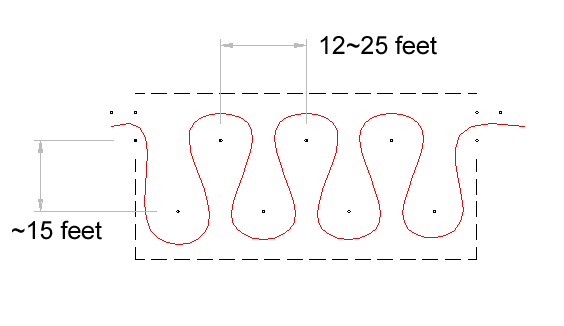
Tall cones are best but short cones are acceptable. Boundary lines should be provided to keep riders from leaving the area and making their turns in the "back 40." The exact spacing of the cones really isn't that important; as long as the rider has to completely change direction within a limited area, the exercise will be effective. Here is a video (3.7MB) showing the offset cone weave on an R1150RT; the bike is probably doing 17' to 19' U-turns.
Other parking-lot exercises
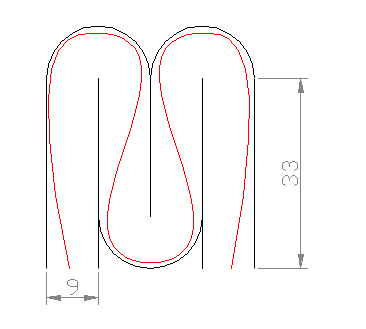
The standard parking space layout (9' x18' spaces) presents easy opportunities for most people to practice for a minute here and there. Working up to 2-space (18') U-turns is a great accomplishment by itself, but there is more fun to be had:
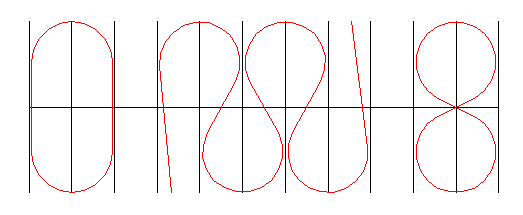
The "Eliminator," the triple U-turn written about in BMWON, is very similar to the middle pattern shown above: