Airhead ignition
/2 and earlier
Magneto. Popular upgrade is the MZ-B or the Pentacom plate. These systems are covered in great detail on Duane Ausherman's site so there's no need to cover it here.
/5 through '78: exposed points
Points and condensor, twin coils. The camshaft has a long 'nose' on which the advance mechanism mounts. The points plate is fastened to the timing chain cover, and is rotated to adjust the timing.
When the key is turned on, power is applied to the coils, which ground through the points. When the points open, the coil sparks.
Correct points setting involves both the opening moment and the fully-open gap. Because the points are opened by a cam, the gap determines how long they are open and how long they are closed. The closed time, or dwell, can be thought of as the 'charging time' for the coils, where too much will overheat them and too little will result in a weak spark. Dwell is not specified by BMW, but a proper points gap will result in about 78° dwell for most bikes, 110° for some early ones.
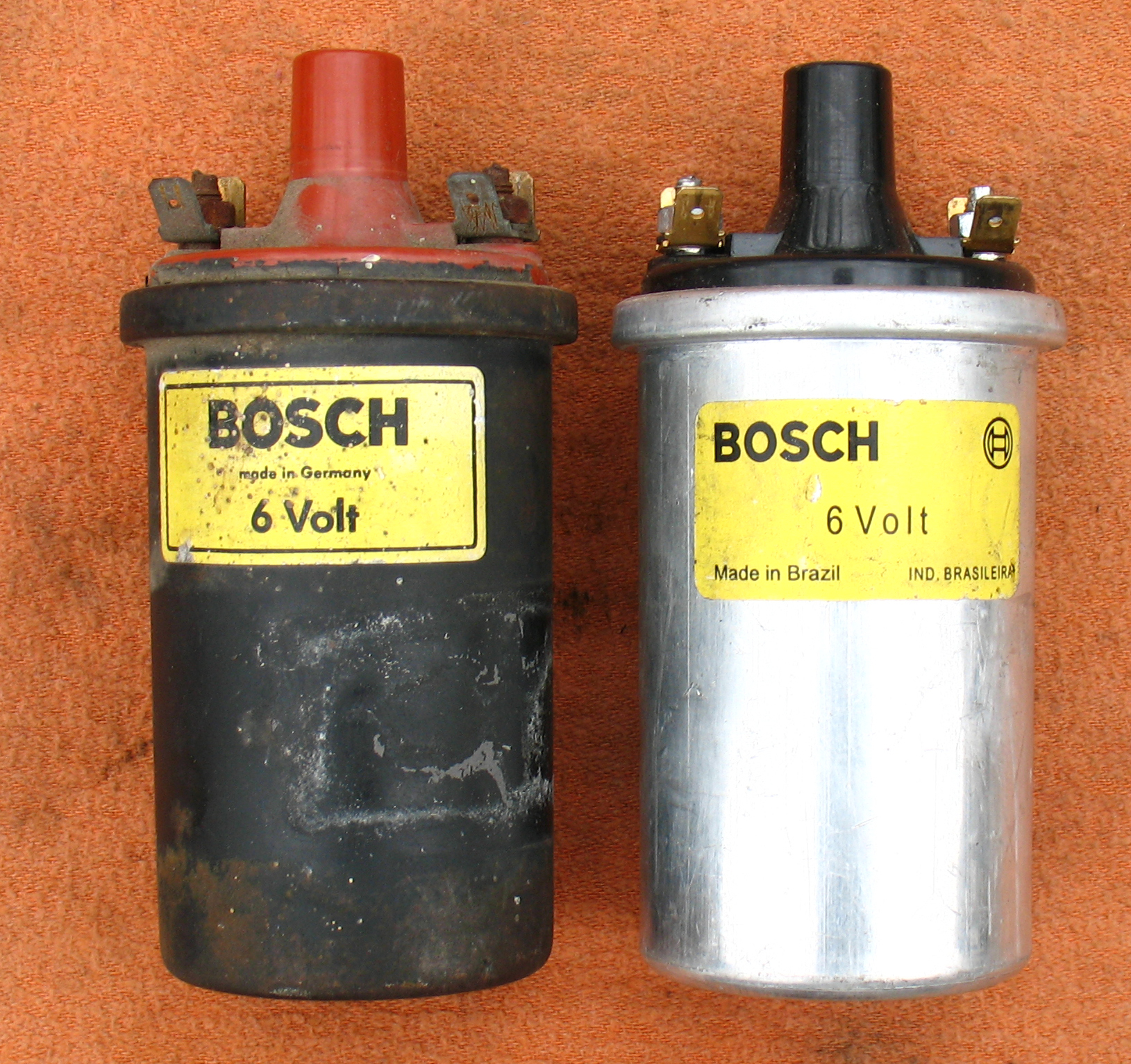
Total coil resistance should be about 3 Ohms for points ignition, which usually means two 1.5 Ohm coils like the ones shown here. The short ones shown are 12 13 1 243 452, Bosch 0 221 100 028, with 6k~7k Ohms secondary, and the new taller one (not shown, from Motorrad Elektrik) is Bosch 0 221 124 001 with about 15k Ohms secondary. An alternative is the dual output Dyna green coil.
'79 and '80: points in can
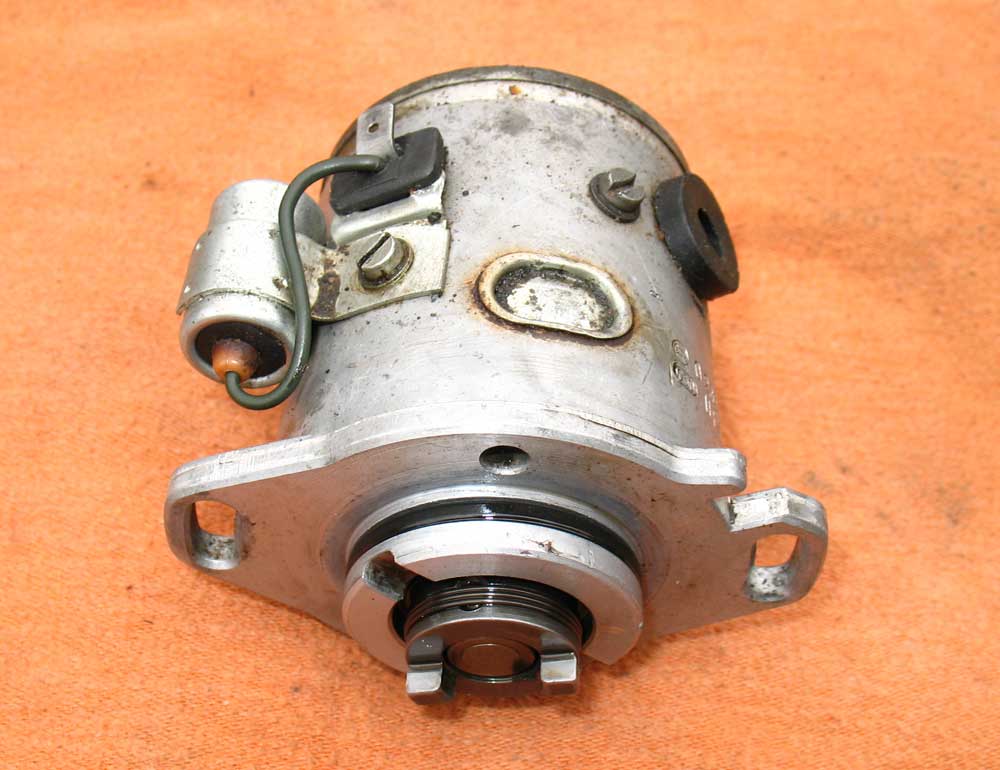
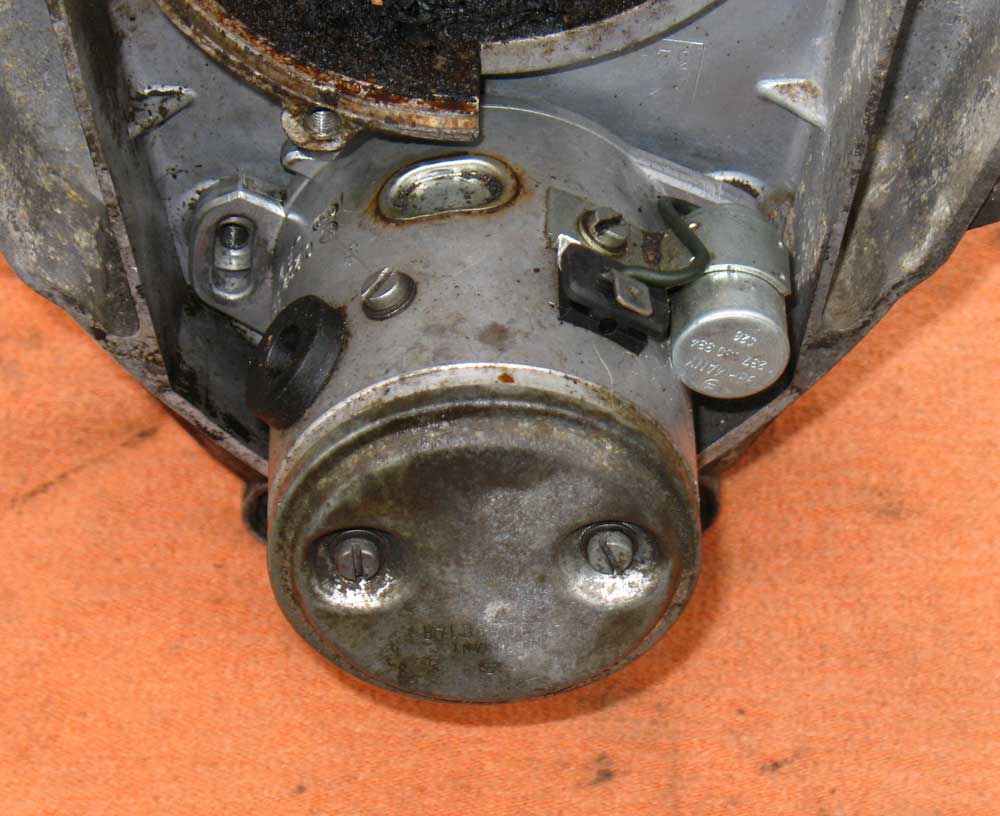
Same dual coils as before, and the points are in an enclosed canister mounted to the timing case where the cam nose was. The condenser is mounted on the outside of the canister. The camshaft has a blunt nose with an offset slot across it, and the canister has a matching part to engage that slot. The timing chain cover is different, as the mounting for the canister differs from the points plate mounting.
The points can is completely rebuildable. The points and condenser can be replaced individually, and the advance mechanism can be cleaned. Because it stays so clean, it's a pretty robust system. Dwell is 120°.
'81-on: electronic ignition

The canister is similar to the previous one but now it contains a hall-effect sensor with a centrifugal advance. The signals go to the ignition control module (ICM), which is mounted on the right side of the frame backbone. That module controls the dwell time and grounds the coil. Because of the difference in the dwell time, the coils have less resistance and therefore charge faster. There are three basic versions of this system.
1) Existing models kept the twin 6V coils, but now they were 0.7 Ohms each. 12 13 1 244 143 with the lightning bolt sticker. This lasted through 1984, when they got upgraded to the single-coil system. The ICM had white or pink lettering with part number 12 14 1 244 477 [or just the molded Bosch part number 0 227 100 103 - unverified].
2) New models (like the G/S and ST) got a single dual-output coil with 1.5 Ohms resistance. BMW 12 13 1 243 910, Bosch 0 221 500 200, known as gray coils, are prone to failure by cracking. Some fail without any visible cracks whatsoever. It's a good idea to replace these coils wherever they appear. The later black coil, or Dyna brown, or many other coils with a 1.5 Ohm primary winding can be used. Same ICM as above.

3) Around 1991 the black coil (BMW 12 13 1 244 426, Bosch 0 221 500 203) was introduced. This coil has a 0.5~0.6 Ohm primary resistance. The ICM was simultaneously upgraded so that it cut off coil power after 1.2 seconds of inactivity, to prevent overheating damage to the coil, and presumably was rated to handle the higher current draw of the new coil. These ICMs have turquoise lettering (shown here) rather than white or pink. BMW recommended against using the new coil with an older ICM lacking the time cut-off. It's a good idea to periodically remove the module and apply some heat-sink paste between the module and the cooling plate (on older models with separate heat sink).
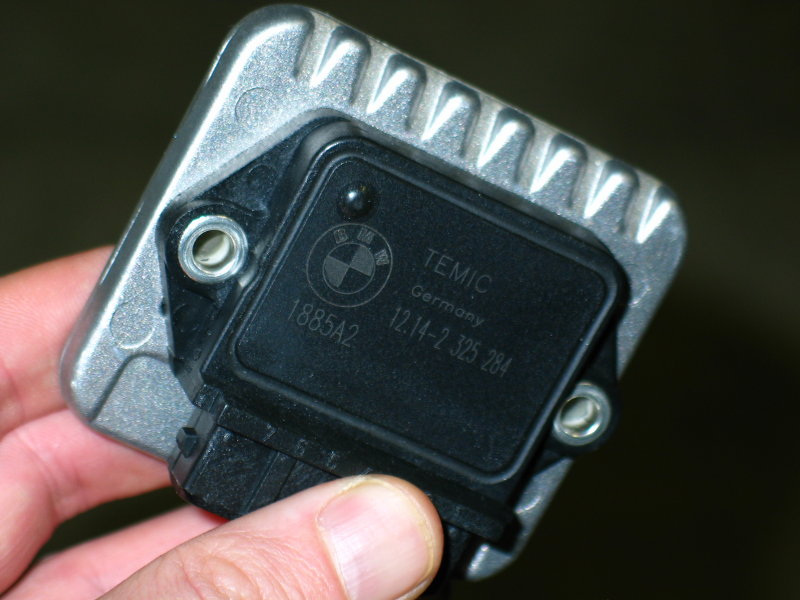
Interestingly enough the functional difference in resistance between the gray and black coils did not concern BMW very much, as they said it was OK to use the new module with the old (gray) coil. At some point I hope to measure dwell from all of these units.
Even more recently, the ICM was upgraded again, now marked with the current part number 12 14 2 325 284 (Temic #1885A2) and integral heat sink.
For some strange reason, BMW never got away from the mechanical timing advance. Besides the early coil problem, sticking advance mechanisms are the only significant weakness of this system.
Replacement ICMs are available from the aftermarket, but I don't know which BMW version they are equivalent to. One such replacement is the Transpo BM300.
The Accel 140404 two-output coil is commonly used for dual-plug bikes; it is 0.7 Ohms. Two are used in series; each replacing a 6V coil.
To revert an '81-on model to points, simply install a '79-'80 points canister and run a wire from its condensor directly to the black with on the coils. Of course the coils themselves need to have 3 Ohms resistance in that case.
How-to of canister disassembly
How to add a second Hall sensor to the canister
Aftermarket
Boyer-Bransden
Boyer's MkIII (now Micro Digital) and Micro-Power systems replace the entire timing system, implementing an electronic pickup and digital control over timing and dwell. The system mounts in place of the points plate and advance mechanism on '70-'80 systems (inside the canister on '79 and '80 models). Micro Digital works with existing coils, while Micro-Power uses Boyer's own coils and is easily fitted to dual plug heads.
Dyna
The Dyna III ignition is an electronic upgrade, using an electronic pickup mounted on the cam nose. Advance is still handled by the stock advance unit.
Dyna also has a booster module, used to reduce the current load on the points. This is especially popular for dual-plug applications where two coils are charging from one signal.
Emerald Island
This is a replacement for the '81-on ignition trigger canister. The canister contains only the sensors and trigger wheel; the advance is done electronically by an external module, which plugs into the stock wiring harness. The advance curve actually extends a bit farther than the stock one does. Very solid unit, with a machined aluminum case and ball bearings supporting the shaft. Main advantages: lower cost than a replacment canister from BMW, the individual sensors are easily replaced, and the advance is done electronically.
'79~'80 systems can be retrofitted with this in conjunction with an ICM and an ignition wiring harness.
Omega
The Omega system is a pickup and processor unit mounted at the alternator, so it gets the signal directly from the crankshaft position. The points can even stay in place as a backup system. 16 timing curves from which to choose, uses existing coils.
Silent-Hektik
Like the Omega, this is a crank-mounted system. A trigger wheel is mounted to the alternator rotor, and the pickup unit is on the stator. The system also includes a processor unit (with 16 advance curves from 18° to 37°) and their own dual-output coil. The processor can power two of these coils for dual-plug heads.
Resources
Motorrad Elektrik - supplier of many Airhead electrical parts, including Dyna coils and ignition systems.
Beemershop - stocks an extensive list of the Emerald Island products.
FKN Enterprises - Potential supplier of Omega ignitions. Good FAQ page, though.
Rocky Point Cycle - supplier of Boyer-Bransden ignitions for BMW.
Boyer-Bransden, good technical background information.
Silent-Hektik, typically counterintuitive German website.
Dyna (aka Dynatek).

